
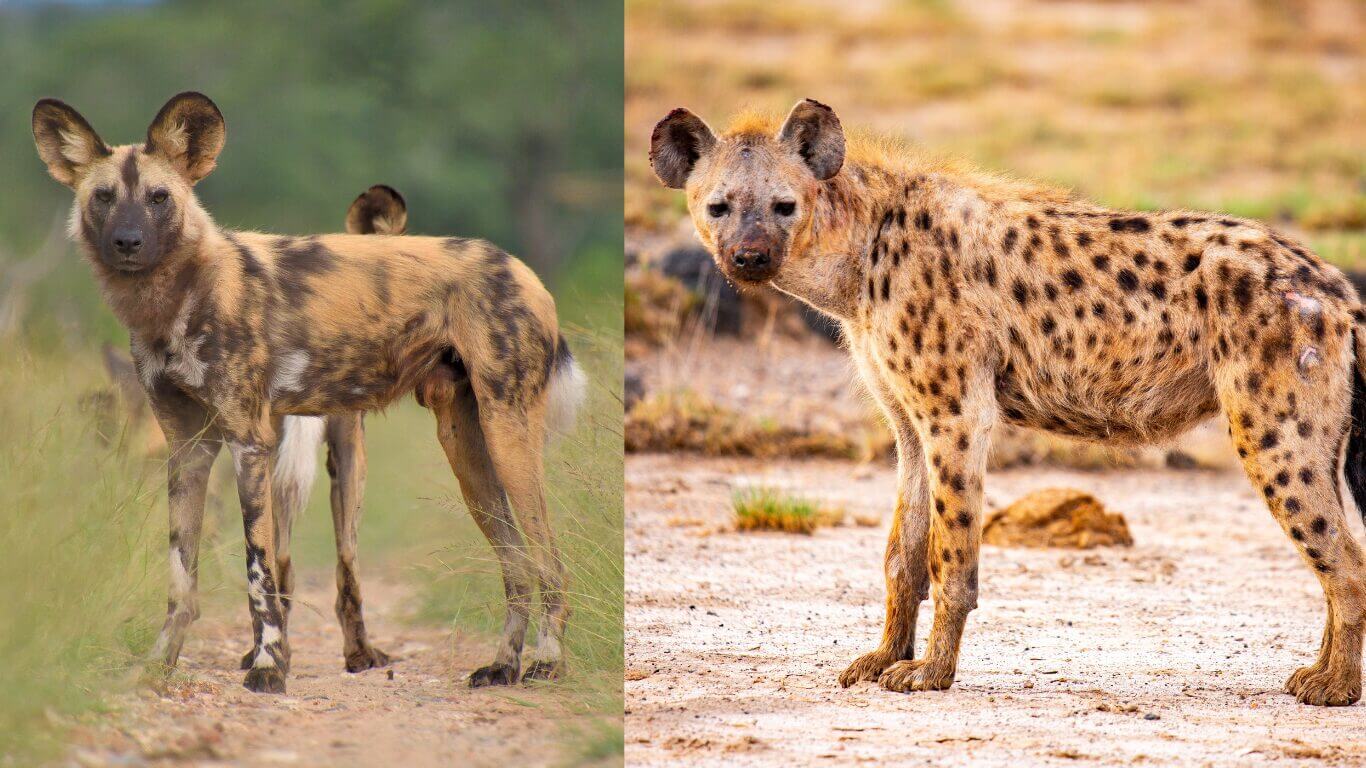
Introduction to African Painted Dogs and Spotted Hyenas
At first glance, these two predators are often believed to be related, but in reality, they are from two different families altogether! These two species share similar habitats, but are vastly different in terms of biology and ecological roles. When looking closer, both species have distinct appearances, different hunting strategies, and unique social behaviors. Being able to identify and understand the differences between the two species is essential to each of their respective conservation efforts, so let’s dive in!
Both species can be found today in sub-Saharan Africa and, historically, had much overlap within their native ranges. African painted dog packs can be found in savannas, arid zones, or forested areas, but prefer the more open space that is seen with the first two ecosystems. Spotted hyenas, historically, could also be found across Eurasia, but no longer occupy that range and now reside solely in Africa. Spotted hyenas are found in a wider variety of ecosystems as compared to the African painted dog. Hyena clans can be found in semi-deserts, savannas, open woodland, dense dry woodland, and mountainous forests.


Conservation Status and Population Numbers
The conservation status of African painted dogs is listed as “endangered” by the International Union for Conservation of Nature (IUCN) Red List, and the population is found scattered between 39 distinct subpopulations through Southern and Eastern Africa. Due to human conflicts, habitat loss, and diseases, there are an estimated 6,000 African painted dogs remaining in the wild. This is a major contrast to spotted hyenas, which are listed as “least concern” by the IUCN Red List, with an estimated population between 27,000 and 47,000 individuals. Outside of protected areas, hyena populations are in decline due to human conflicts, habitat loss, and disease, which are all challenges similar to what the African painted dog faces.
Are African Painted Dogs Related to Hyenas?
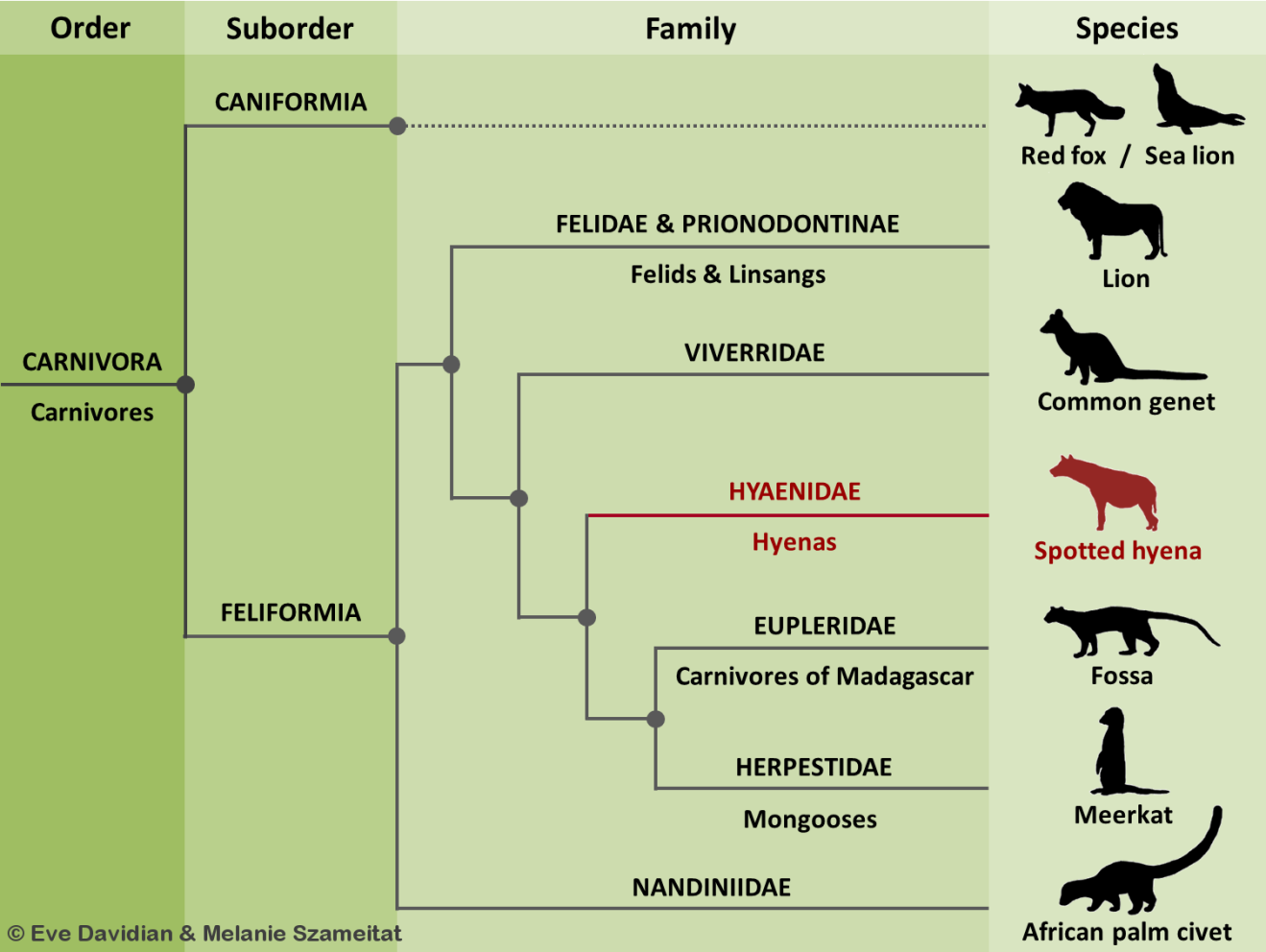
African painted dogs and hyenas belong to entirely different taxonomic groups. Taxonomy refers to the scientific classification of organisms, and a taxonomic group is formed based on characteristics of those organisms and can be broken down into categories. The categories are as follows: Kingdom, Phylum, Domain, Class, Order, Family, Genus, and Species. These categories can then be further specified into subcategories.
African painted dogs (Lycaon pictus) are members of the family Canidae, which falls under the suborder Caniformia - the “dog-like” carnivores - within the order Carnivora. This family includes well-known species like the domestic dogs, wolves, foxes, maned wolves, and jackals.
Spotted hyenas (Crocuta crocuta) belong to the family Hyaenidae, which falls under the suborder Feliformia - the “cat-like” carnivores- within the order Carnivora. The Hyaenidae family consists of four species of hyena: the spotted hyena, striped hyena, brown hyena, and the aardwolf. The Hyaenidae family is closely related to other feliform families such as Eupleridae, which contains carnivores of Madagascar, and Herpestidae, which consists of species of mongoose.
How to Tell the Difference Between African Painted Dogs and Spotted Hyenas
Size and Physical Build
Though many people think these two species look similar, in reality, they are very different. Both species have Here are some characteristics that set the two species apart. African painted dogs are much smaller than spotted hyenas. Both male and female African painted dogs fall within a weight range of 45-60 pounds. Occasionally, male African painted dogs will be larger than females, but that is not always the case. Spotted hyenas, however, have what is called sexual size dimorphism between males and females. This means that based on gender, their sizes differ, and in this case, females are often much larger and have an average weight between 120- 155 pounds, while males average 90-130 pounds.
Fur Patterns, Coloration, and Markings
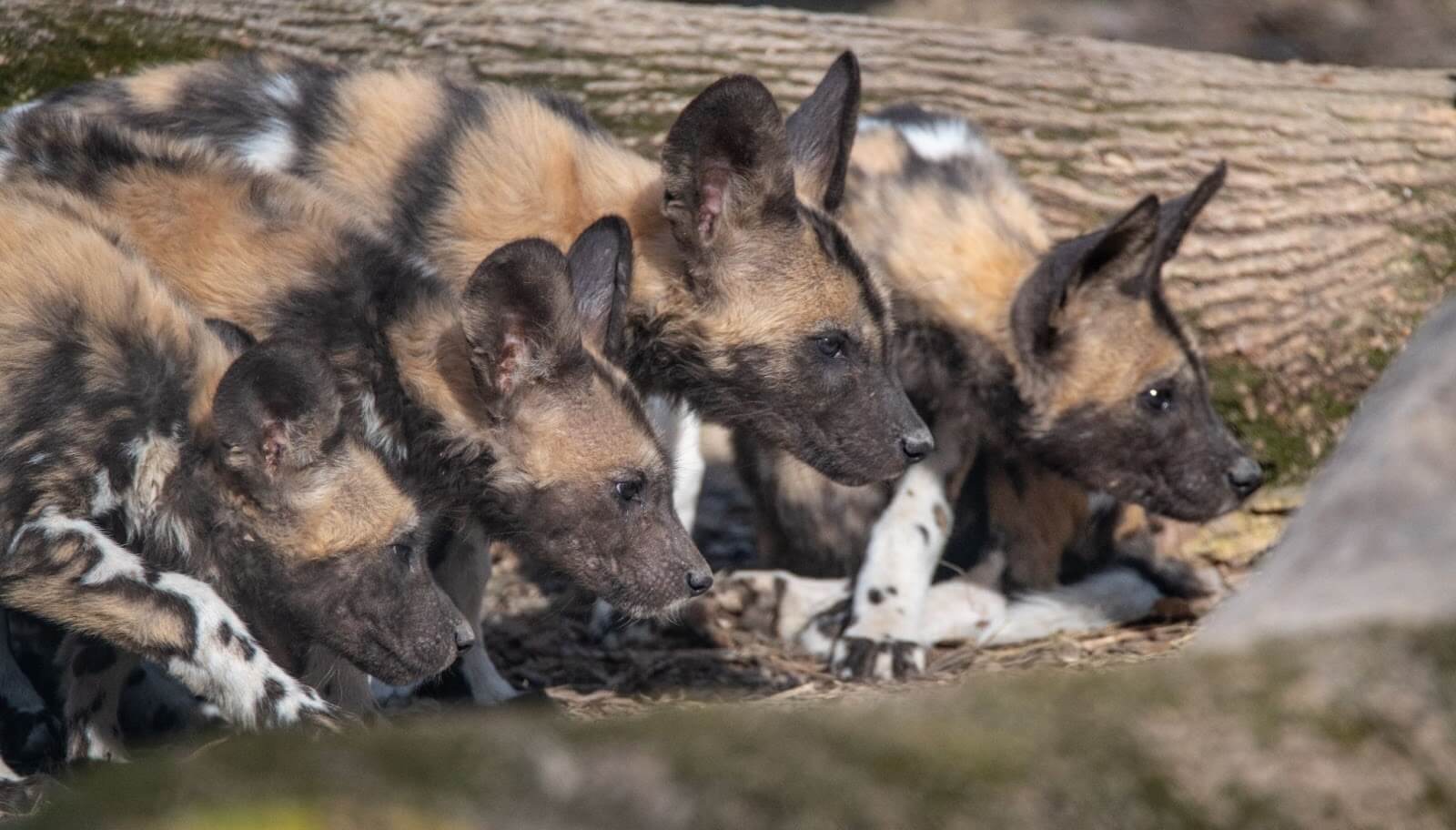
African painted dogs have unique markings of black, tan, dark brown, and white on their fur, which gives them their “painted” name. Their facial markings are typically a dark muzzle, tan cheeks, and a black strip running up between their eyes. Their body markings, however, are asymmetrical and unique to each dog, similar to how we as people have our own unique fingerprints!
African painted dogs can use these markings to aid in identifying each other from 160-330 feet away. They have large, rounded, black ears that allow for excellent hearing while also keeping them cool in the hot climate they live in. The blood vessels that run through the thin skin of the ears release heat into the surrounding air. That cooled blood is then pumped back into the animal’s body to keep their core body temperature lower.
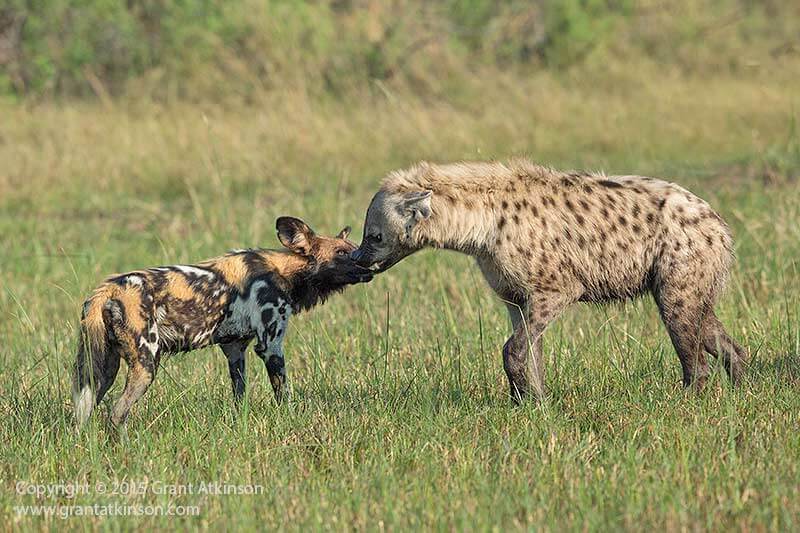
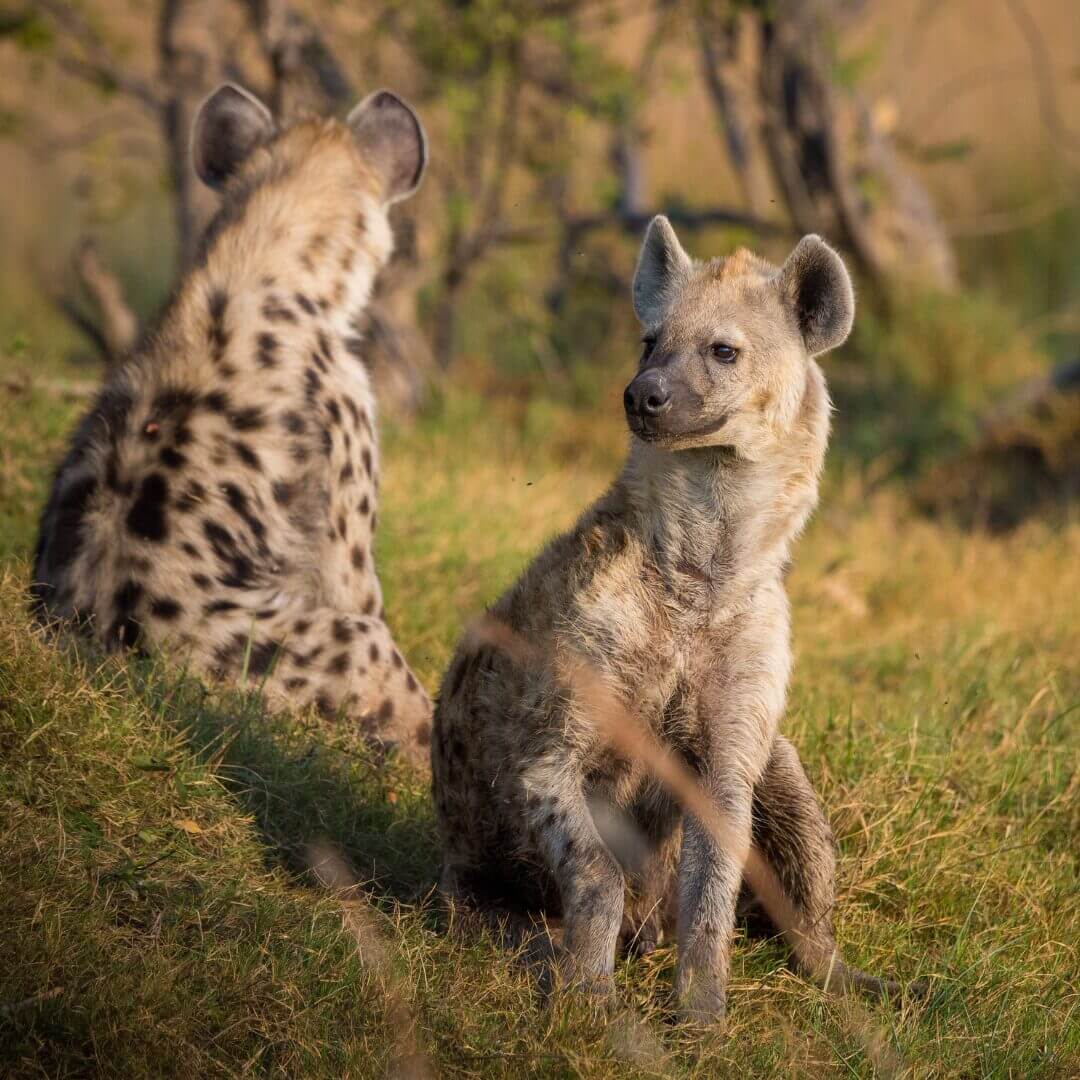
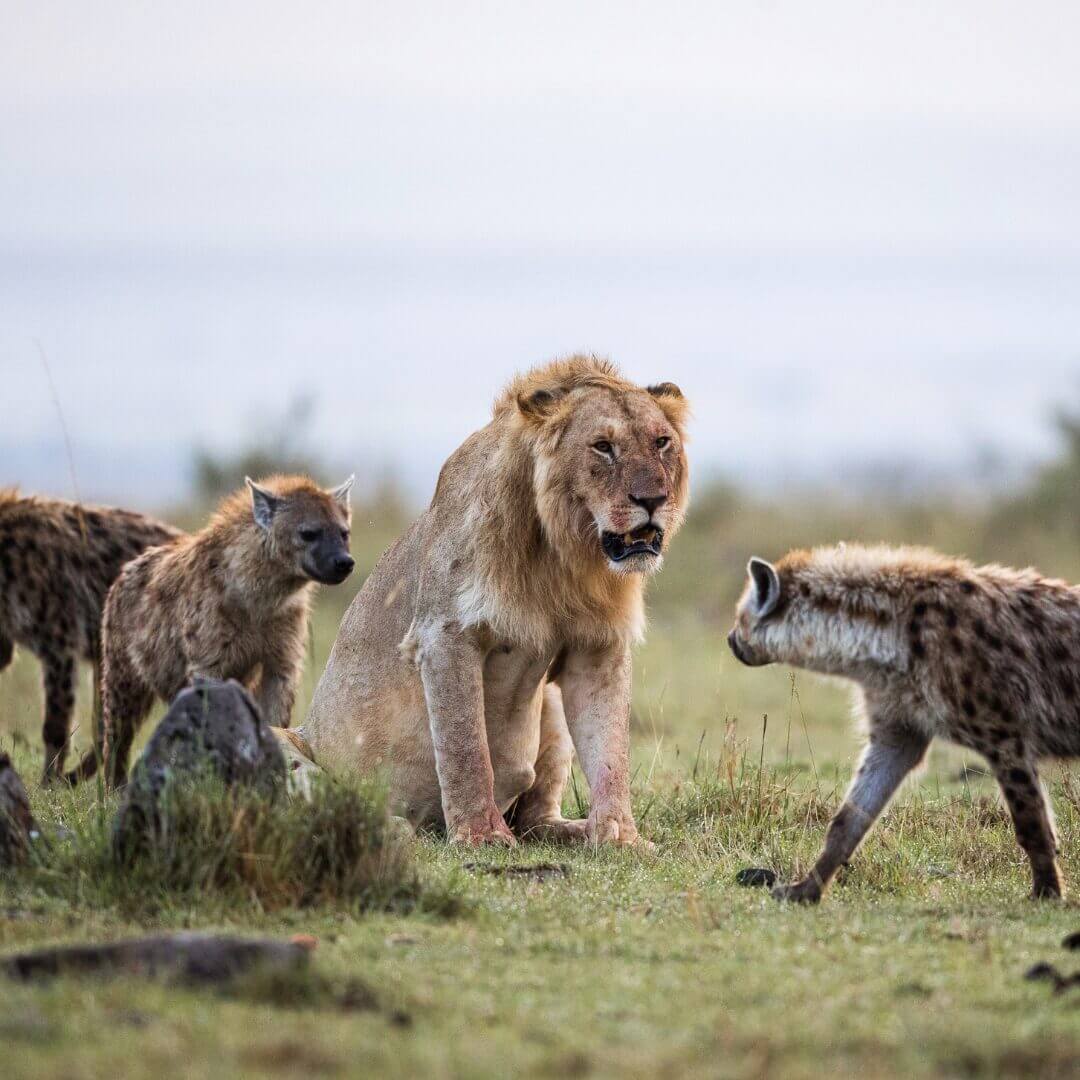
Spotted hyenas are the largest member of their family with a vaguely bear-like build, tan to dark-brown fur with dark spots, a long, muscular neck, a large skull with a strong jaw, and small, rounded ears with a slight point at the top.
For side-by-side comparisons, a spotted hyena will be much taller and bulkier than an African painted dog that is shorter and leaner. While both animals can have spotted fur colors, the African painted dogs will be more variable in patterns for each individual, while a group of hyenas will all have similar spotted, black markings.
One unique trait that sets spotted hyenas apart from African painted dogs is that males and females can be difficult to distinguish based on external features. Female spotted hyenas have an elongated clitoris, often called a “pseudopenis,” through which they urinate, mate, and give birth. They’re also the only mammal without an external vaginal opening; the labiae are fused to create a "pseudoscrotum," which makes their anatomy resemble that of a male hyena. While this trait is biologically significant, it can make it tricky to tell the sexes apart in the wild.
What Do African Painted Dogs and Hyenas Eat, and How Do They Hunt?
How African Painted Dogs Hunt
African painted dogs and spotted hyenas are two of the top predators that live in Africa and are very efficient hunters. Both can be observed hunting in groups for similar foods, but have different behaviors socially when consuming and sharing food.
A hunting group of African painted dogs will hunt small to medium-sized ungulates (hooved animals) such as gazelles, antelopes, or impalas, and occasionally as large as wildebeests. African painted dogs are highly successful at hunting, with a success rate of 60-80%. This is the highest of all canid species! In comparison, wolves are only successful when hunting about 10-20% of the time.
How do they do it? African painted dogs perform cooperative hunting as a group, covering large distances to find prey, and typically do not scavenge for their food. They utilize high-pitched vocalizations to communicate as a group while chasing prey. These high frequencies allow them to remain undetected by the prey and other predators. The hunting group will consist of the best hunters in the pack, and each individual has a role within that group to aid in finding and hunting prey. With high stamina, African painted dogs have the ability to run for up to three miles and maintain an average speed of 37 miles per hour. Individuals in the hunting group alternate who is the front-runner to tire out the prey. In short bursts, African painted dogs have been documented running up to 45 miles per hour. Once the prey is tired out, they bring it to the ground as quickly as possible by aiming for the prey’s flank, throat, or nose.
The pack consumes their prey rapidly, as competitors like lions or hyenas may chase them away or kill them for the food they have hunted. This competition has led the African painted dog to develop an incredibly strong bite force – the strongest in the canid family. This allows them to easily bite through bones or tough body tissues to eat as fast as they can. Depending on the size of the hunting group, African painted dogs can consume a medium-sized prey item, such as a gazelle, in as little as 10-15 minutes. They will engorge themselves on the food and can carry up to a quarter of their body weight in their stomach to be regurgitated for members of the pack that did not go hunting. An estimated capacity for what their stomach can hold is just under 20 pounds! There is no hierarchical feeding structure within the pack; African painted dogs make sure that every packmate has access to food, including pups, injured or sick dogs, and those who stayed behind to care for the others.
How Spotted Hyenas Hunt
Spotted hyenas hunt similar-sized prey, but are able to take down larger ungulates like zebras and occasionally giraffes. A hyena’s hunting strategy heavily relies on opportunism or scavenging for food, but are also highly efficient at hunting when in a group, with a success rate of 50-90%. Hyenas also consume all animal matter, including other animal waste.
Spotted hyenas are most commonly seen hunting in a small group, but they have also been seen hunting alone for small prey or in larger groups to hunt larger prey. When alone, a hyena will use stealth and their sharp senses to hunt small prey like birds or rodents. When in a group, they “test chase” a herd of prey in an attempt to single out an older, younger, or weaker individual within the herd. If unsuccessful in the test chase, the hyenas will give up and look for another herd. If they are successful, they work to further separate that individual from the herd and take it down quickly.
Hyenas also have high stamina and utilize long endurance chases like the African painted dog. They can run at a top speed of 37 miles per hour and can maintain that speed until they tire their prey out. Spotted hyenas typically will not bring food back for the rest of the clan or their young since mothers will nurse their young for a much longer time than other species.
How Do African Painted Dogs and Hyenas Live, Communicate, and Reproduce?
African Painted Dog Social Structure and Family Life
African Painted dogs have intricate and strong social bonds; it is extremely rare to see solitary hunting and living. Packs today are around 20-30 individuals, but historically, packs as large as 50-60 animals were documented.
African painted dogs have over 20 different vocalizations, some so high-pitched that the human ear cannot hear them. These vocalizations range from high-pitched chirps and chitters to a lower vocalization called a “hoo” call. The long-distance hoo call can be heard up to 1.2 miles away and can be used as a distress signal by an individual who is lost from their pack, or when the pack is looking for a lost packmate.
The pack follows a matriarchal structure led by a dominant male and female, with the female ranked higher than the male. After the most dominant male, the rest of the pack consists of male and female siblings that assist in hunting and raising pups that the dominant pair produces. Males and females will disperse in same sexed units when they are two to three years old. Packs form when a group of females accepts an unrelated group of males. On occasion, females that do not take the dominant position will disperse again, while males will stay with the pack for the rest of their lives.
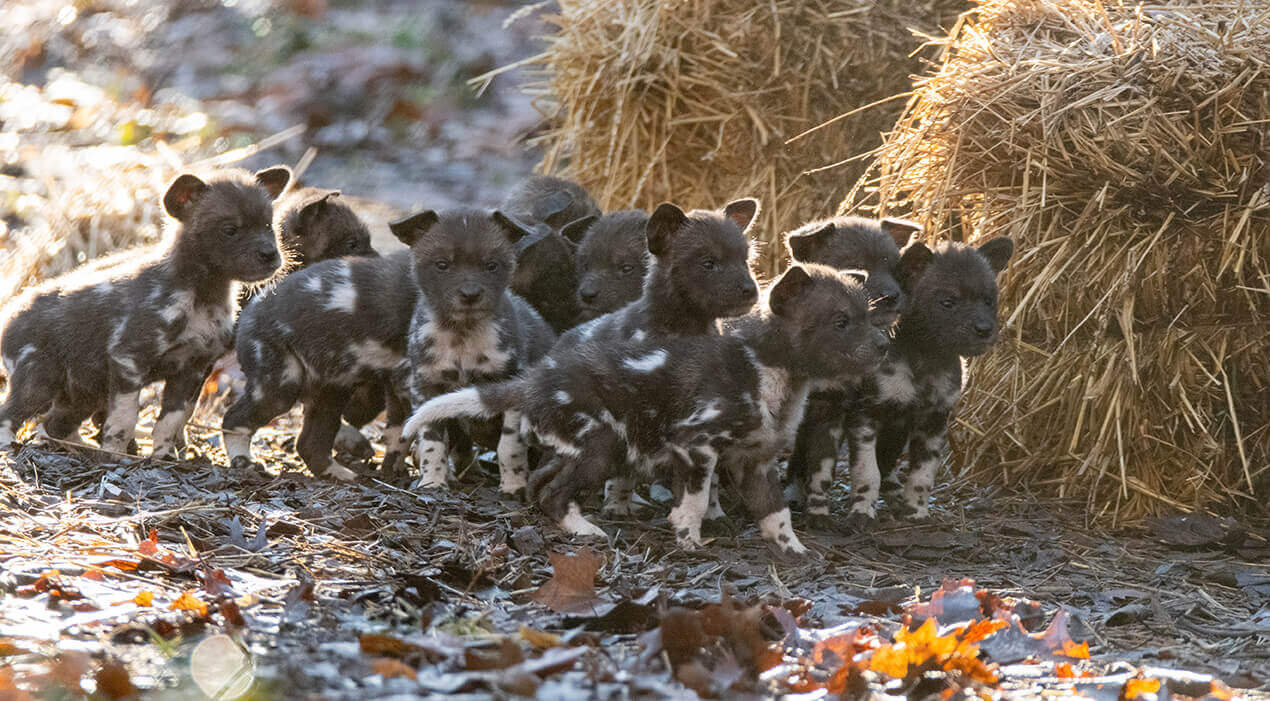
The dominant male and female African painted dog bond as a monogamous pair for life. They are usually the only pack members that breed and have pups. Females have a gestation period of 60-80 days and can have a litter size between 6-16 pups, with an average of 10 pups. Due to this large litter size, subordinates within the pack often do not have pups, because it would be very difficult to find the amount of food required to support so many growing pups.
The entire pack works together to raise the pups. While the dominant female is in the den caring for her pups, the hunting pack will bring food to the mother so she can remain nourished and care for them. African painted dog pups are born with their eyes and ears closed and are very reliant on their mother for the first few weeks of life. Pups begin to eat solid foods regurgitated by the adults around three to five weeks old, but won’t leave the den until 12-16 weeks old. Once the pups are old enough to begin following the hunting pack, typically around 4-5 months old, the young will eat prey first while the older hunters watch out for predators.

Spotted Hyena Social Structure and Family Life
Spotted hyenas also live in large clans, with females at the top in a matriarchal social structure. These clans are compact and unified, but not as closely-knit as African painted dogs. In the matriarchy, the highest-ranking female and her descendants are dominant over all other individuals in the clan (in biological terms, this is called nepotistic). No pair bonds are formed. It is common for hyenas to have several mates over the course of several years. Opposite from African painted dogs, the females in a clan will stay with the natal group, while the males disperse around 2 years old and live in a group before settling with a new clan.
These clans can vary in size, some being as large as 80 individuals! They also have an extensive vocalization range, with sounds like whoops, grunts, groans, giggles, growls, whines, and the most recognizable being grunt-laughs. The pitch of the laugh indicates the hyena’s age, and the variations in the frequency convey the animal’s rank within the clan. This can be especially important for males new to a clan, as they go immediately to the bottom of the hierarchy when they arrive. Establishing oneself and quickly learning who is who within the clan may give these individuals a better chance of improving their own status. Similar to an African Painted dog’s hoo call, the Spotted hyena’s whoops with long intervals are primarily used to signal that two individuals have become separated. Grunts and soft growls are heard when hyenas of the same clan come into close contact with one another.
All of the females within the clan can pair with a male and have offspring. The average gestation for a spotted hyena is 110 days, with a litter size of 1-2 cubs. Birth can be traumatic for the female, as she gives birth through the narrow pseudopenis. This organ will rupture to facilitate the passage of her cubs and can take weeks to heal.
Hyena cubs are born with their eyes open and in the first weeks after birth can attack each other, which may result in the death of the weaker cub. The clan utilizes a communal den with underground channels to help protect cubs from predation when the mother is away from the den. Despite being in a communal den, there is no communal care for offspring. Female spotted hyenas raise their young alone, and males do not take part in raising them. Females give birth in the den, and within 10 days, the cubs can move around the den efficiently. The rank of the cub is also dependent on the presence of the mother; low-ranking adults may act aggressively towards higher-ranking cubs if the mother is absent for too long from the den. Mother hyenas do not regurgitate food for their young, but nurse them for 12-16 months, despite the cubs being able to process solid foods starting at 3 months of age. Cubs begin to display hunting behaviors around 8 months of age, and by one year old, they can join the hunting group.
How to Support African Painted Dogs
At the Endangered Wolf Center, we care for a pack of African painted dogs. Come visit the Endangered Wolf Center for a tour and have the chance to learn about their story here in our care. For many, this is the first time to learn about this incredible species, and we hope that this impactful experience inspires them to advocate for wildlife here in the US and across the world.
You can make a lasting impact for this endangered species—symbolically adopt our African painted dog pack today! Your support helps us introduce more people to this extraordinary species and inspires action to protect wildlife both here at home and around the world.

Adopt our African Painted Dog Pack
The African Painted Dog, known commonly as the African wild dog, is one of the most endangered mammals in the world. Your symbolic adoption of our African Painted Dog pack includes a special adoption package.